

The New Great Game: Analyzing China’s Belt and Road Initiative (BRI) Through the Lens of the Ancient Silk Road
💡 Introduction: The Reawakening of a Continental Dream
For centuries, the Silk Road was more than just a trade route; it was the world’s first interconnected global network, facilitating the exchange of goods (silk, spices), technology (paper, gunpowder), and ideas (Buddhism, Islam) between East and West. It symbolized an era of shared prosperity and mutual cultural enrichment.
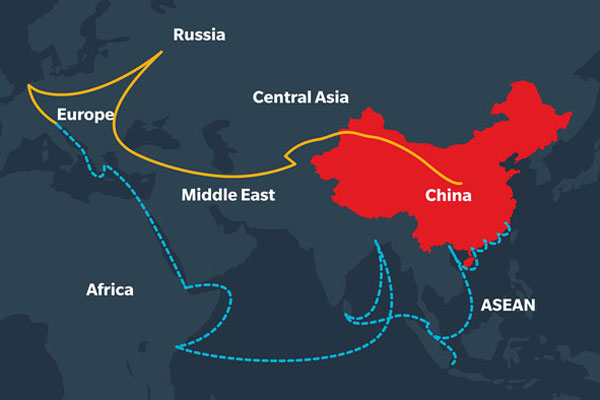
In 2013, Chinese President Xi Jinping announced the launch of the Belt and Road Initiative (BRI), a massive, multi-trillion dollar infrastructure project spanning over 150 countries. The BRI, often branded as the "New Silk Road," explicitly invokes the romantic, mutually beneficial image of its ancient predecessor.
However, the comparison is complex and often misleading. While the ancient Silk Road was a decentralized, organic network of decentralized merchants and caravans, the modern BRI is a highly centralized, state-driven, and strategic geopolitical project backed by state-owned banks and aimed at securing long-term economic and political influence for Beijing.
This Trusted Time analysis moves beyond the romantic rhetoric. We will draw a clear historical comparison between the ancient Silk Road and the modern BRI, dissecting the fundamental differences in their economic models, trade priorities, and geopolitical goals. We aim to determine whether the BRI is a path to shared prosperity or a sophisticated tool of strategic dependency.
Part I: Ancient Silk Road—The Organic, Decentralized Network
The success of the historical Silk Road (c. 130 BCE – 1453 CE) lay in its adaptive, bottom-up nature.
1. Economic Model: Exchange, Not Debt
The ancient Silk Road was an exercise in decentralized exchange driven by supply and demand.
Merchant-Driven: Trade was conducted by private merchants who bore the financial risks and operated based on local market needs. There was no single, state-mandated financing entity.
Commodity Exchange: The primary financial transaction involved the exchange of high-value, low-weight luxury goods (silk, porcelain, tea) for gold, silver, or unique Western products. The core mechanism was barter and mutual exchange, which did not create lasting sovereign debt.
Shared Infrastructure: Infrastructure was organic—caravan stops, oases, and protected resting places—and maintained by the local states and communities along the route, who directly benefited from transit fees and local trade.
2. Geopolitical and Cultural Impact
The historical route fostered profound cultural synthesis and regional autonomy.
Cultural Synthesis: The route’s greatest legacy was the spread of religion, science, and art. The local states (e.g., in Central Asia and Persia) served as autonomous cultural hubs, enriching the network rather than simply serving as transit points.
Lack of Hegemon: No single empire, not even the Han or Roman Empires, ever controlled the entire length of the Silk Road. The network was resilient precisely because control was fragmented, allowing local powers to thrive independently.
Part II: The Belt and Road Initiative (BRI)—The Centralized, Strategic Model
The BRI, in contrast, is an ambitious, planned project with clear political and economic control emanating from Beijing.
3. Economic Model: Credit and Dependency (The Debt Trap)
The BRI is predominantly a state-funded lending operation, fundamentally different from the ancient model of private exchange.
State-Driven Finance: The project is financed primarily by Chinese state-owned banks (like the China Development Bank and Export-Import Bank of China). Projects are financed through massive, often high-interest, loans to developing nations.
The "Build and Control" Model: Infrastructure is largely built by Chinese state-owned companies using Chinese labor and materials, limiting the local economic multiplier effect. The goal is to create captive markets for Chinese goods and services.
The Debt Trap: The strategic core of the BRI is often cited as its "debt trap diplomacy." When nations (e.g., Sri Lanka, Pakistan) default on high-interest loans, China gains strategic control over the asset, such as a port (Hambantota, Sri Lanka) or a critical resource corridor, thereby securing long-term geopolitical leverage.
4. Strategic Goals: Geopolitics and Security
While the ancient route was about maximizing profit, the modern route is about maximizing influence.
Energy Security: A key goal is securing vital supply lines for China’s massive energy consumption. New pipelines and maritime routes reduce China’s reliance on shipping lanes vulnerable to potential geopolitical rivals (like the Strait of Malacca).
Expanding Political Influence: The BRI is a direct challenge to the US-led post-World War II global order. It creates a Sino-centric trading and political bloc, offering developing nations an alternative (non-Western) financing and development model.
Internal Stability: The BRI also aims to boost development in China’s underdeveloped western provinces, integrating them economically with Central Asia and enhancing border stability.
Part III: The South Asian Perspective and Future Outlook
The BRI's impact is most acutely felt in China's immediate neighborhood, particularly in South Asia, where infrastructure projects hold major political implications.
5. The China-Pakistan Economic Corridor (CPEC)
The CPEC, the flagship BRI project, highlights both the promise and the peril of the initiative:
Promise: Massive infrastructure investment (roads, power plants) aimed at upgrading Pakistan's economy.
Peril: Pakistan now carries billions in debt to China, and Chinese control over the Gwadar Port provides Beijing with a strategic maritime gateway to the Arabian Sea, bordering India. This project directly alters the balance of power in the Indian Ocean Region.
6. India's Response and the Road Ahead
India has consistently refused to join the BRI, citing sovereignty concerns over CPEC projects passing through disputed territory (Gilgit-Baltistan).
The Counter-Narrative: India, alongside the U.S. and its allies, is actively pursuing counter-initiatives, such as the India-Middle East-Europe Economic Corridor (IMEC), designed to offer an alternative, transparent, and debt-free investment model to partner nations.
The Future of Global Trade: The BRI has cemented China as the world's chief infrastructure builder and creditor. However, as nations struggle with debt repayments and asset seizure clauses, the long-term sustainability and popularity of the BRI model are increasingly being questioned. Future success will depend less on the scale of investment and more on the transparency and ethical governance of the lending mechanism.
Conclusion: From Organic Exchange to Centralized Strategy
The ancient Silk Road thrived on mutual benefit, decentralization, and cultural exchange, leaving behind a legacy of shared historical wealth. The modern BRI, though powerful, is a strategic state tool predicated on massive credit, centralized control, and long-term geopolitical influence.
While the ancient route sought to connect cultures, the modern route seeks to connect economies to a single, dominant hub. The ultimate lesson is that while history inspires rhetoric, it is the underlying economic model—exchange vs. debt—that defines the true geopolitical nature of a global trade network. Nations must scrutinize the fine print of BRI deals, focusing on sovereignty and long-term financial sustainability over short-term infrastructure gains.
